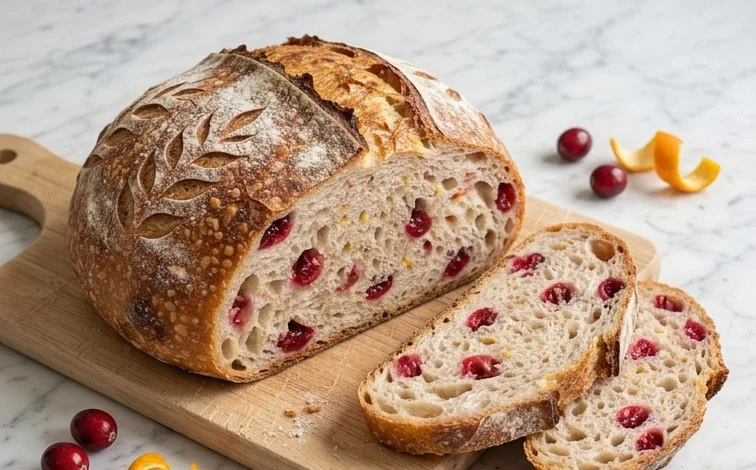
Cranberry Orange Sourdough Bread brings together festive flavors in a wonderfully chewy loaf. The bright tang of the sourdough starter is the perfect counterpoint to the sweet, slightly tart cranberries and the fragrant orange zest. It’s a bread that feels like a special occasion, wonderful served warm with butter for brunch, or as an accompaniment to a comforting soup. I love making this loaf when I want something a little more involved, something that rewards patience with incredible depth of flavor and a beautiful crust. The process, while requiring a few steps, is quite meditative. You get to watch the dough transform, and the aroma as it bakes is truly wonderful. This Cranberry Orange Sourdough Bread is a delightful way to use your active starter and impress friends and family.
Ingredients:
- 50 g active sourdough starter
- 50 g bread flour
- 50 g water
- 350 g water
- All of the levain (the mixture from the first three ingredients)
- 500 g bread flour
- 10 g salt
- 100 g dried cranberries
- Zest of one orange
- 20 g honey or maple syrup, optional
Making sourdough bread is a bit like nurturing a living thing, and this Cranberry Orange Sourdough is a testament to that. The tangy sourdough base pairs beautifully with the sweet chewiness of dried cranberries and the bright, aromatic zest of orange. It’s a bread that feels special, perfect for a weekend brunch or a cozy afternoon snack. We’ll be building this loaf in stages, which is typical for sourdough, allowing the fermentation process to develop flavor and structure.
Building the Levain
The first step is to create our levain, which is essentially a small starter dough that will kickstart the main dough’s fermentation. In a clean jar or bowl, combine the 50 g of active sourdough starter, 50 g of bread flour, and 50 g of water. Mix this thoroughly until there are no dry bits of flour. Cover it loosely and let it sit at room temperature for about 4 to 8 hours, or until it has doubled in size and is bubbly. You’ll know it’s ready when a small spoonful floats in water. This is the “all of the levain” we’ll use later.
Mixing the Dough
Once your levain is ready, it’s time to mix the main dough. In a large mixing bowl, combine the 500 g of bread flour with the 350 g of water. Stir just until there are no dry patches of flour. This is called the autolyse, and it helps the flour absorb water and begin gluten development. Let this mixture rest, covered, for 30 minutes to an hour.
After the autolyse, add the prepared levain (all of the bubbly mixture from the first step) to the bowl. Add the 10 g of salt and the optional 20 g of honey or maple syrup if you’re using it. Honey or maple syrup adds a subtle sweetness and can help with browning, but the bread is delicious without it too. Now, begin mixing. The best way to incorporate everything is by using your hands. Squish and squeeze the dough until the levain, salt, and honey (if used) are fully integrated. The dough will feel shaggy and sticky at this stage. Continue mixing and folding the dough in the bowl for about 5-10 minutes until it starts to come together more smoothly.
Bulk Fermentation and Folds
This is where the magic of sourdough really happens. We need to let the dough ferment and develop strength. Place the dough in a clean, lightly oiled bowl or container. Cover it. Over the next 3 to 4 hours, you’ll perform a series of “stretch and folds” every 30-45 minutes. To do a stretch and fold, wet your hands slightly to prevent sticking. Reach under one side of the dough, stretch it up gently, and fold it over the center. Rotate the bowl a quarter turn and repeat this process with the remaining three sides. This builds the gluten structure without aggressive kneading. You’ll notice the dough becoming smoother and more elastic with each set of folds. After about 3-4 sets of folds, let the dough rest, covered, for the remainder of the bulk fermentation time, until it has increased in volume by about 30-50% and looks airy. The total bulk fermentation time, including the resting periods between folds, will be around 4-6 hours, depending on your room temperature. Warmer rooms will speed things up.
Adding Inclusions
About an hour before you plan to shape your dough, it’s time to add the cranberries and orange zest. Gently incorporate the 100 g of dried cranberries and the zest of one orange into the dough. You can do this by lightly stretching the dough and sprinkling the cranberries and zest over it, then folding them in. Be gentle to avoid deflating the dough too much. Aim to distribute them as evenly as possible throughout the dough mass. This step is best done after the bulk fermentation has mostly completed, so the dough has developed enough structure to hold the inclusions.
Shaping and Proofing
Once the bulk fermentation is complete and the inclusions are mixed in, it’s time to shape the dough. Lightly flour your work surface. Gently tip the dough out of its bowl onto the floured surface. Perform a final, gentle pre-shape by bringing the edges of the dough into the center, creating a loose round. Let it rest for about 20-30 minutes, covered, to relax the gluten. Then, perform your final shape into a round (boule) or an oval (batard), depending on your baking vessel. Be firm but gentle to create surface tension.
Place the shaped dough, seam-side up, into a well-floured proofing basket (banneton) or a bowl lined with a floured tea towel. Cover the basket or bowl. For the final proof, you can either leave it at room temperature for 1-2 hours until it looks puffy and a gentle poke springs back slowly, or for a more developed flavor and easier scoring, refrigerate it overnight (8-16 hours). Refrigerating also makes the dough firmer and easier to handle for scoring.
Baking the Bread
Preheat your oven with a Dutch oven or baking stone inside to 240°C (475°F) for at least 30-45 minutes. If using a Dutch oven, preheat it with the lid on. Once the dough has finished its final proof, carefully turn it out onto a piece of parchment paper or directly into the hot Dutch oven. If you refrigerated it, score the top of the dough with a sharp knife or lame to allow it to expand evenly during baking.
Baking in a Dutch Oven: Carefully place the dough into the hot Dutch oven, put the lid on, and bake for 20 minutes. Then, remove the lid and continue baking for another 20-25 minutes, or until the crust is a deep golden brown and the internal temperature reaches at least 96°C (205°F).
Baking on a Baking Stone: If using a baking stone, slide the dough (on parchment paper) onto the hot stone. Create steam in your oven by placing a tray of hot water on the bottom rack or by spraying the oven walls with water (be careful of the steam). Bake for 20 minutes, then remove the steam source and continue baking for another 20-25 minutes until the crust is golden brown.
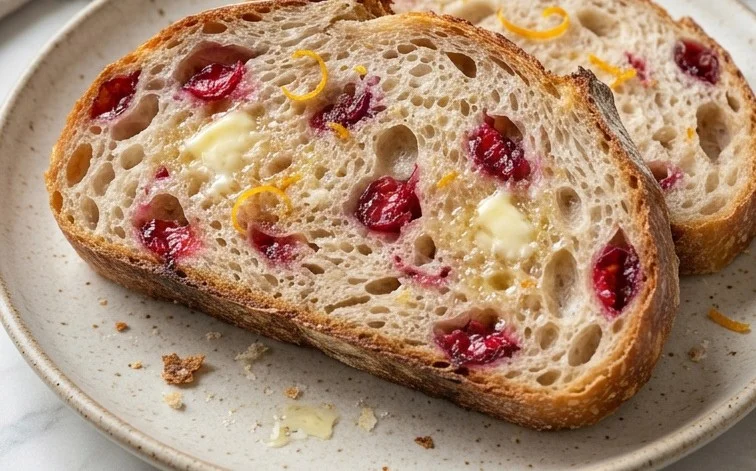
Once baked, transfer the bread to a wire rack to cool completely before slicing. This is important to allow the crumb to set. Slicing too early can result in a gummy texture. This bread is wonderful on its own, toasted with butter, or served alongside a hearty soup or stew.
Conclusion:
This Cranberry Orange Sourdough Bread is a truly rewarding bake, combining the complex tang of sourdough with the bright, festive notes of orange and the chewy sweetness of cranberries. It’s a loaf that looks as good as it tastes, with a beautiful crust and an open crumb. Serving it warm with a smear of butter or alongside a hearty stew makes any meal feel special. Consider adding a handful of chopped walnuts for extra texture, or a pinch of cinnamon to enhance the warming spice notes.
Serving Suggestions: This bread is fantastic toasted and buttered, served alongside a holiday meal, or even as the base for French toast. It also pairs wonderfully with cheese.
Variations: For a different citrus note, try lemon zest instead of orange. If you don’t have dried cranberries, dried cherries or chopped apricots also work well.
Frequently Asked Questions
Can I use active dry yeast instead of sourdough starter?
This recipe is specifically designed for sourdough starter to achieve its characteristic tang and texture. Using active dry yeast would result in a very different bread, more akin to a standard yeasted loaf.
How should I store my Cranberry Orange Sourdough Bread?
Once completely cooled, store the bread at room temperature in a bread box or a loosely tied paper bag for up to 3 days. For longer storage, you can slice the bread and freeze it. Toast slices directly from frozen.
Why is my sourdough loaf dense?
Dough density can be caused by several factors: an inactive starter, under-fermentation, or over-fermentation. Ensuring your starter is active and bubbly before you begin, and carefully monitoring the dough during bulk fermentation and proofing, are key to a lighter loaf.
Cranberry Orange Sourdough Bread
A delicious and tangy sourdough bread infused with the festive flavors of cranberries and orange.
Ingredients
-
{‘@type’: ‘Ingredient’, ‘name’: ‘active sourdough starter’, ‘amount’: ’50’, ‘unitCode’: ‘g’}
-
{‘@type’: ‘Ingredient’, ‘name’: ‘bread flour’, ‘amount’: ’50’, ‘unitCode’: ‘g’}
-
{‘@type’: ‘Ingredient’, ‘name’: ‘water’, ‘amount’: ’50’, ‘unitCode’: ‘g’}
-
{‘@type’: ‘Ingredient’, ‘name’: ‘water’, ‘amount’: ‘350’, ‘unitCode’: ‘g’}
-
{‘@type’: ‘Ingredient’, ‘name’: ‘levain’, ‘description’: ‘all of the levain from the previous step’}
-
{‘@type’: ‘Ingredient’, ‘name’: ‘bread flour’, ‘amount’: ‘500’, ‘unitCode’: ‘g’}
-
{‘@type’: ‘Ingredient’, ‘name’: ‘salt’, ‘amount’: ’10’, ‘unitCode’: ‘g’}
-
{‘@type’: ‘Ingredient’, ‘name’: ‘dried cranberries’, ‘amount’: ‘100’, ‘unitCode’: ‘g’}
-
{‘@type’: ‘Ingredient’, ‘name’: ‘zest of one orange’}
-
{‘@type’: ‘Ingredient’, ‘name’: ‘honey or maple syrup’, ‘optional’: True, ‘amount’: ’20’, ‘unitCode’: ‘g’}
Instructions
-
Step 1
Prepare the levain: Mix 50g active sourdough starter, 50g bread flour, and 50g water. Let it ferment at room temperature for 4-12 hours, or until doubled and bubbly. -
Step 2
Autolyse: In a large bowl, combine 500g bread flour and 350g water. Mix until just combined and let it rest for 30 minutes. -
Step 3
Combine ingredients: Add the prepared levain and 10g salt to the autolysed dough. Mix thoroughly until well incorporated. Knead for 5-10 minutes until the dough is smooth and elastic. -
Step 4
Bulk Fermentation: Over the next 3-4 hours, perform a series of stretch and folds every 30 minutes. Incorporate the dried cranberries and orange zest during the last two stretch and folds. -
Step 5
Shaping and Cold Retardation: Shape the dough into your desired loaf shape. Place it in a well-floured banneton or bowl, cover, and refrigerate for 12-24 hours. -
Step 6
Baking: Preheat your oven with a Dutch oven to 450°F (230°C). Score the top of the dough and carefully place it in the hot Dutch oven. Bake for 20 minutes with the lid on, then remove the lid and bake for another 20-25 minutes, or until golden brown and cooked through.
Important Information
Nutrition Facts (Per Serving)
It is important to consider this information as approximate and not to use it as definitive health advice.
Allergy Information
Please check ingredients for potential allergens and consult a health professional if in doubt.



Leave a Comment