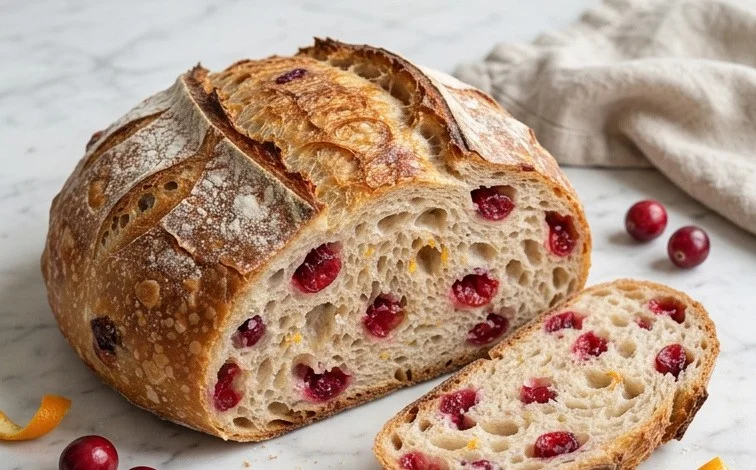
Cranberry Orange Sourdough Bread brings a festive touch to any table, even outside of the holiday season. The combination of tart dried cranberries and the bright fragrance of orange zest cuts beautifully through the slightly sour character of naturally leavened bread. It has a satisfyingly chewy crumb with a crisp, golden crust, making it perfect for a special breakfast or a comforting snack. I love how the simple ingredients come together to create something so complex in flavor and texture. Making this loaf is a rewarding process, and while sourdough takes time, the results are absolutely worth the patience. You’ll get a bread that’s far superior to most store-bought options, with a unique tang and delightful bursts of fruit. Let’s get this dough started.
Mixing the Dough
The first step is preparing your levain, which is essentially a small starter dough that gets your main dough going. In a clean jar or small bowl, combine the 50 g of active sourdough starter, 50 g of bread flour, and 50 g of water. Give it a good stir until there are no dry bits of flour left. Cover it loosely and let it sit at room temperature for about 4 to 8 hours, or until it has doubled in size and is bubbly. This indicates it’s active and ready to work its magic. The exact time will depend on the temperature of your kitchen and the activity of your starter. Once your levain is ready, it’s time to mix the main dough. In a large bowl, combine the active levain, 350 g of water, and 500 g of bread flour. Mix until just combined, ensuring no dry flour remains. This is a shaggy, wet dough. Cover the bowl and let it rest for 30 minutes for autolyse. After the rest, add the 10 g of salt, 100 g of dried cranberries, the zest of one orange, and 20 g of honey or maple syrup, if using. Mix thoroughly with your hands, squeezing and folding the ingredients into the dough until the salt and additions are evenly distributed. The dough will feel sticky, but keep working it until it’s cohesive. This part can take about 5-10 minutes. You’re looking for a dough that is starting to feel smoother and more elastic.
Ingredients:
- 50 g active sourdough starter
- 50 g bread flour
- 50 g water
- 350 g water
- all of the levain
- 500 g bread flour
- 10 g salt
- 100 g dried cranberries
- zest of one orange
- 20 g honey or maple syrup, optional
Cranberry Orange Sourdough Bread
This Cranberry Orange Sourdough Bread is my go-to when I want something a little special, but still comforting and familiar. The tartness of the cranberries and the bright, zesty aroma of orange really shine through the slightly tangy crumb of the sourdough. It’s got a wonderful crust and a soft, chewy interior that makes it perfect for toasting with a little butter, or even just enjoying on its own. Making sourdough can seem daunting at first, but with a bit of patience and practice, you’ll be pulling loaves like this out of your oven too. Let’s get started on creating this delicious bread.
Mixing the Dough
The first step is preparing your levain, which is essentially a small starter dough that gets your main dough going. In a clean jar or small bowl, combine the 50 g of active sourdough starter, 50 g of bread flour, and 50 g of water. Give it a good stir until there are no dry bits of flour left. Cover it loosely and let it sit at room temperature for about 4 to 8 hours, or until it has doubled in size and is bubbly. This indicates it’s active and ready to work its magic. The exact time will depend on the temperature of your kitchen and the activity of your starter.
Once your levain is ready, it’s time to mix the main dough. In a large mixing bowl, add the 350 g of water and all of the prepared levain. Stir this together until the levain is mostly dissolved. Then, add the 500 g of bread flour and the 10 g of salt. If you’re using the honey or maple syrup for a touch of sweetness and to aid in browning, add that now too. Mix everything together with your hands or a sturdy spoon until a shaggy dough forms and there are no dry patches of flour visible. It will look quite messy at this stage, and that’s perfectly fine. We’re not aiming for smoothness yet.
Developing the Dough
Now comes the part where we develop the gluten structure. This is called the bulk fermentation period, and it involves a series of “stretch and folds.” Let the dough rest, covered, for about 30 minutes. After this rest, wet your hands slightly to prevent sticking. Reach under one side of the dough, gently stretch it upwards, and fold it over to the opposite side. Rotate the bowl a quarter turn and repeat this stretching and folding motion for all four sides. This process strengthens the dough by aligning the gluten strands.
Perform these stretch and folds every 30 to 60 minutes for about 2 to 3 hours. As you continue with the folds, you’ll notice the dough becoming smoother, more elastic, and less sticky. It will start to hold its shape better. Between folds, make sure the dough is covered to prevent a dry skin from forming on the surface. The room temperature plays a role here; a warmer kitchen will speed up fermentation, while a cooler one will slow it down. You’re looking for the dough to increase in volume by about 30-50% and to feel airy and lively.
After the stretch and folds are complete, it’s time to incorporate the additions. Gently spread the dough out on a lightly floured surface. Scatter the 100 g of dried cranberries and the zest of one orange evenly over the surface. Then, carefully fold the dough over itself a few times to distribute the cranberries and zest throughout the dough. Try not to overwork it at this stage; you want the additions to be evenly dispersed without tearing the dough too much. The scent of orange will already start to fill the air.
Shaping and Proofing
Once the cranberries and orange zest are incorporated, it’s time to shape the dough. Lightly flour your work surface again. Gently scoop the dough onto the floured surface. Form the dough into your desired shape, usually a round (boule) or an oblong (batard). To shape a boule, gently pull the edges of the dough towards the center, creating tension on the surface, and then cup your hands around it, rotating it to form a smooth, taut ball. You can also use a bench scraper to help guide and tighten the shape.
Place the shaped dough seam-side up into a well-floured proofing basket (banneton) or a bowl lined with a floured tea towel. If you don’t have a proofing basket, a regular bowl works, but make sure it’s generously floured to prevent sticking. Cover the basket or bowl with plastic wrap or a damp tea towel to keep the dough from drying out. Now, the dough needs to proof. You have two main options: a warm proof or a cold proof. For a faster result, you can let it proof at room temperature for about 2 to 3 hours, or until it looks puffy and springs back slowly when gently poked. Alternatively, and often preferred for sourdough development, you can do a cold proof in the refrigerator for 12 to 24 hours. This develops more complex flavors and makes the dough easier to handle for scoring.
Baking the Bread
When you’re ready to bake, preheat your oven to 230°C (450°F). If you are using a Dutch oven, place it in the oven while it preheats. This will create a steamy environment that helps the bread achieve a beautiful, crispy crust. Once the oven is fully preheated and the dough has finished its final proof, carefully turn the dough out of its proofing basket onto a piece of parchment paper. If you did a cold proof, the dough will be firm and easy to handle.
If you’re using a Dutch oven, carefully remove the hot pot from the oven. Gently transfer the dough (on the parchment paper) into the hot Dutch oven. Cover with the lid. If you’re not using a Dutch oven, you can place the dough directly on a preheated baking stone or sheet and create steam by placing a pan of hot water on the rack below. Bake covered for 20 minutes. After 20 minutes, remove the lid from the Dutch oven (or remove the water pan if not using a Dutch oven). Continue baking for another 20-25 minutes, or until the crust is a deep golden brown and the internal temperature of the bread reaches 96-99°C (205-210°F) when measured with an instant-read thermometer.
Let the bread cool completely on a wire rack before slicing. This is an important step; cutting into hot bread can make the crumb seem gummy. Letting it cool allows the interior to set properly. Enjoy your delicious homemade Cranberry Orange Sourdough Bread!
Conclusion:
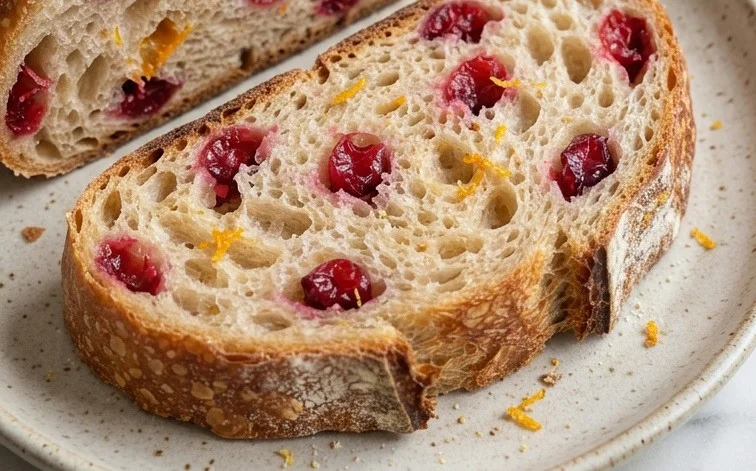
This Cranberry Orange Sourdough Bread is a delightful loaf that balances the tang of sourdough with sweet-tart cranberries and bright orange zest. It’s a recipe that rewards your patience with a beautiful crust, a soft, chewy interior, and a flavor profile that’s both comforting and a little bit exciting. It’s perfect for enjoying toasted with butter, alongside a soup or salad, or simply on its own. Don’t be intimidated by sourdough; this recipe is a great way to practice and build confidence. The scent of this bread baking will fill your home with warmth and anticipation. I find that the subtle sweetness from the honey or maple syrup, while optional, really rounds out the flavors beautifully, but it’s also wonderful without it if you prefer a more pronounced tang. Give this Cranberry Orange Sourdough Bread a try, and I’m sure you’ll love it as much as I do.
Frequently Asked Questions:
Can I use fresh cranberries instead of dried?
Yes, you can use fresh cranberries, but you might want to reduce their quantity slightly as they contain more moisture and can make the dough wetter. About 75-80g of fresh cranberries should work well. You may also need to slightly increase the baking time to ensure they are cooked through and softened.
My sourdough starter isn’t very active. What can I do?
Ensure your starter is being fed regularly with equal parts flour and water by weight. Try feeding it twice a day for a few days leading up to making the levain. Warmer kitchen temperatures (around 75-80°F or 24-27°C) also encourage faster activity. If it’s still sluggish, it might need more time to mature or a different feeding ratio. Always use a starter that has at least doubled in size and is bubbly before incorporating it into your levain.
How do I store this bread?
Once fully cooled, store the bread in a bread box or a paper bag at room temperature for up to 3 days. For longer storage, slice the cooled loaf and freeze it in an airtight container or freezer bag for up to 3 months. Thaw slices at room temperature or toast them directly from frozen.
Cranberry Orange Sourdough Bread
A delightful sourdough bread bursting with tart cranberries and fragrant orange zest, with a hint of sweetness.
Ingredients
-
50 g active sourdough starter
-
50 g bread flour
-
50 g water
-
350 g water
-
500 g bread flour
-
10 g salt
-
100 g dried cranberries
-
zest of one orange
-
20 g honey or maple syrup, optional
Instructions
-
Step 1
To make the levain: Combine 50g active sourdough starter, 50g bread flour, and 50g water. Mix well, cover, and let it rest for 4-8 hours at room temperature, or until bubbly and doubled in size. -
Step 2
In a large bowl, combine the levain (all of it), 350g water, and 500g bread flour. Mix until just combined, then let it rest for 30 minutes (autolyse). -
Step 3
Add the salt and optional honey/maple syrup to the dough. Mix thoroughly until the salt is dissolved and incorporated. Perform a series of stretch and folds every 30 minutes for the next 2-3 hours until the dough becomes smooth and elastic. -
Step 4
Gently incorporate the dried cranberries and orange zest into the dough. Continue with stretch and folds as needed to evenly distribute them. -
Step 5
Shape the dough into a round or oval and place it in a floured banneton or bowl. Cover and let it proof at room temperature for 1-2 hours, then refrigerate overnight for cold fermentation. -
Step 6
Preheat your oven and Dutch oven to 475°F (245°C). Carefully score the top of the dough and bake covered for 25 minutes. Remove the lid and bake for another 20-25 minutes, or until golden brown and the internal temperature reaches 200-210°F (93-99°C). -
Step 7
Let the bread cool completely on a wire rack before slicing and enjoying.
Important Information
Nutrition Facts (Per Serving)
It is important to consider this information as approximate and not to use it as definitive health advice.
Allergy Information
Please check ingredients for potential allergens and consult a health professional if in doubt.



Leave a Comment